
How to Calculate Simple vs Compound Interest (Easy Comparison Guide)
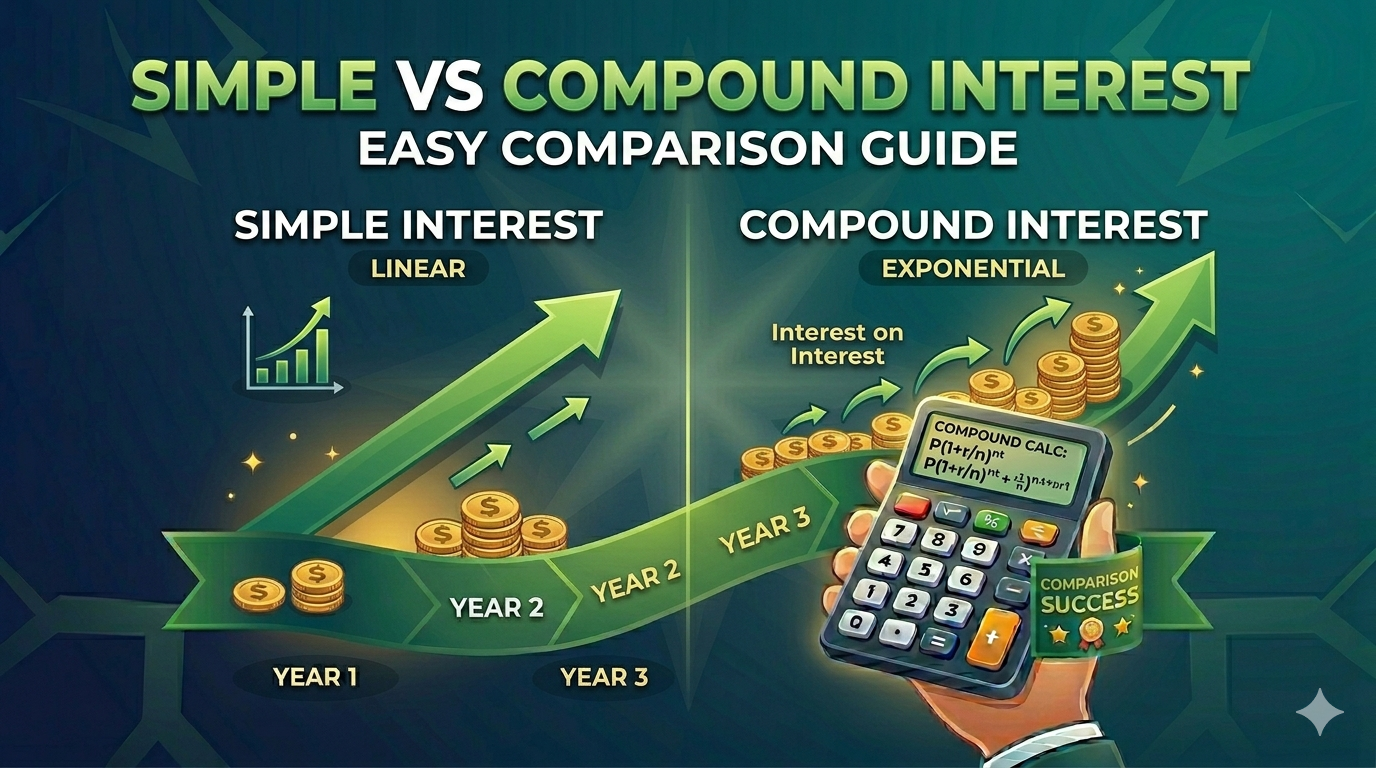
Understanding interest is one of the most important parts of managing money, but many people still feel confused when they hear terms like simple interest and compound interest. They may know that both are ways to calculate interest, but they do not clearly understand how they are different or how to calculate them properly.
This confusion can lead to wrong financial decisions. For example, you might think two investments are similar, but in reality, one can give much higher returns just because it uses compound interest instead of simple interest.
In this detailed guide, you will learn how to calculate both simple and compound interest step by step, understand their differences clearly, and see real examples so that everything becomes easy to understand.
If you want to calculate quickly and accurately without doing manual math, you can use these tools:
👉 Simple Interest Calculator
https://www.calculatemax.com/calculator/simple-interest-calculator
👉 Compound Interest Calculator
https://www.calculatemax.com/calculator/compound-interest-calculator
What is Simple Interest?
Simple interest is the easiest type of interest to understand. In this method, interest is calculated only on the original amount that you invest or borrow.
This means the interest amount stays the same every period because it is always based on the initial amount.
For example, if you invest money and earn simple interest, you will receive the same interest amount every year. It does not increase over time.
This type of interest is commonly used in short-term loans or basic financial calculations.
What is Compound Interest?
Compound interest is more advanced and more powerful. In this method, interest is calculated not only on the original amount but also on the interest that has already been added.
In simple words, it is “interest on interest.”
When you earn interest, it gets added to your total amount. Then the next interest is calculated on this new amount, which makes your money grow faster.
Over time, this creates a strong growth effect, especially for long-term investments.
Key Difference Between Simple and Compound Interest
The main difference between simple and compound interest is how the interest is calculated.
In simple interest, interest is always calculated on the original amount. It stays constant and does not change.
In compound interest, interest is calculated on a growing amount. Because of this, the interest keeps increasing over time.
This small difference creates a big impact, especially in long-term scenarios.
How to Calculate Simple Interest (Step-by-Step)
Calculating simple interest is very straightforward.
First, you take your original amount. Then you apply the interest rate to it for a specific time period.
Since the interest does not change, you can calculate it once and multiply it by the number of periods.
For example, if you are earning interest yearly, you calculate the yearly interest and then multiply it by the number of years.
Even though this is simple, doing it manually for different values can still take time.
👉 You can calculate instantly here:
https://www.calculatemax.com/calculator/simple-interest-calculator
How to Calculate Compound Interest (Step-by-Step)
Compound interest calculation follows a slightly different process.
First, you take your initial amount. Then you calculate interest for the first period and add it to the total.
Now your amount becomes larger.
In the next period, you calculate interest again, but this time on the new total. This process keeps repeating for every period.
Because the amount keeps increasing, the interest also keeps increasing.
👉 You can calculate it easily here:
https://www.calculatemax.com/calculator/compound-interest-calculator
Example 1: Simple Interest in Real Life
Let’s understand simple interest with a practical example.
Imagine you invest an amount at a fixed interest rate for a few years. Each year, you earn the same amount of interest.
This happens because the interest is always calculated on the original amount, not on any additional earnings.
So, if you check your returns every year, you will notice that they remain constant.
This makes simple interest easy to predict, but it also limits growth.
Example 2: Compound Interest in Real Life
Now let’s look at compound interest.
In the first year, you earn interest on your initial amount. This interest is added to your total.
In the second year, you earn interest again, but this time it is calculated on a larger amount.
In the third year, the amount becomes even bigger, and the interest grows further.
As time passes, this growth becomes faster and more noticeable.
This is why compound interest is considered more powerful.
Long-Term Comparison (Very Important)
The real difference between simple and compound interest becomes clear in the long term.
In the short term, both may look similar. The difference in returns may not be very large.
But over a longer period, compound interest starts growing much faster.
Simple interest grows in a straight line, meaning it increases at a constant rate.
Compound interest grows in a curve, meaning it starts slow but becomes much faster over time.
This is why long-term investments always benefit more from compound interest.
When Simple Interest is Used
Simple interest is usually used in situations where calculations need to be easy and predictable.
It is commonly used in short-term loans, basic financial agreements, and simple savings plans.
Because the interest does not change, it is easier to understand and manage.
However, it is not very effective for long-term growth.
When Compound Interest is Used
Compound interest is used in most long-term financial products.
It is used in savings accounts, investments, retirement planning, and many financial systems.
Because it increases returns over time, it is preferred for building wealth.
However, it is also used in loans, where it can increase the total amount you have to repay.
Common Mistakes People Make
Many people make mistakes when dealing with simple and compound interest.
One common mistake is assuming both work the same way. This leads to wrong expectations about returns.
Another mistake is ignoring the time factor. People do not realize how important time is in compound interest.
Some people also do not use calculators and try to estimate values, which leads to errors.
Avoiding these mistakes can help you make better financial decisions.
Which One is Better?
There is no single answer to this question because it depends on your situation.
If you want simple and predictable calculations, simple interest is easier.
If you want maximum growth over time, compound interest is much better.
For long-term savings and investments, compound interest is always the better option.
Why You Should Use Interest Calculators
Even though the concepts are simple, real-life calculations can become confusing, especially when dealing with multiple years or different rates.
A calculator makes everything easy and accurate.
It helps you understand your returns clearly and compare different scenarios.
👉 Use these tools for accurate results:
Simple Interest Calculator:
https://www.calculatemax.com/calculator/simple-interest-calculator
Compound Interest Calculator:
https://www.calculatemax.com/calculator/compound-interest-calculator
Final Thoughts
Understanding the difference between simple and compound interest is very important for managing money and making smart financial decisions.
Simple interest is easy to calculate but limited in growth.
Compound interest is slightly complex but much more powerful over time.
If you understand both properly, you can choose the right option based on your financial goals.
The best approach is to use calculators, stay consistent, and think long-term.