
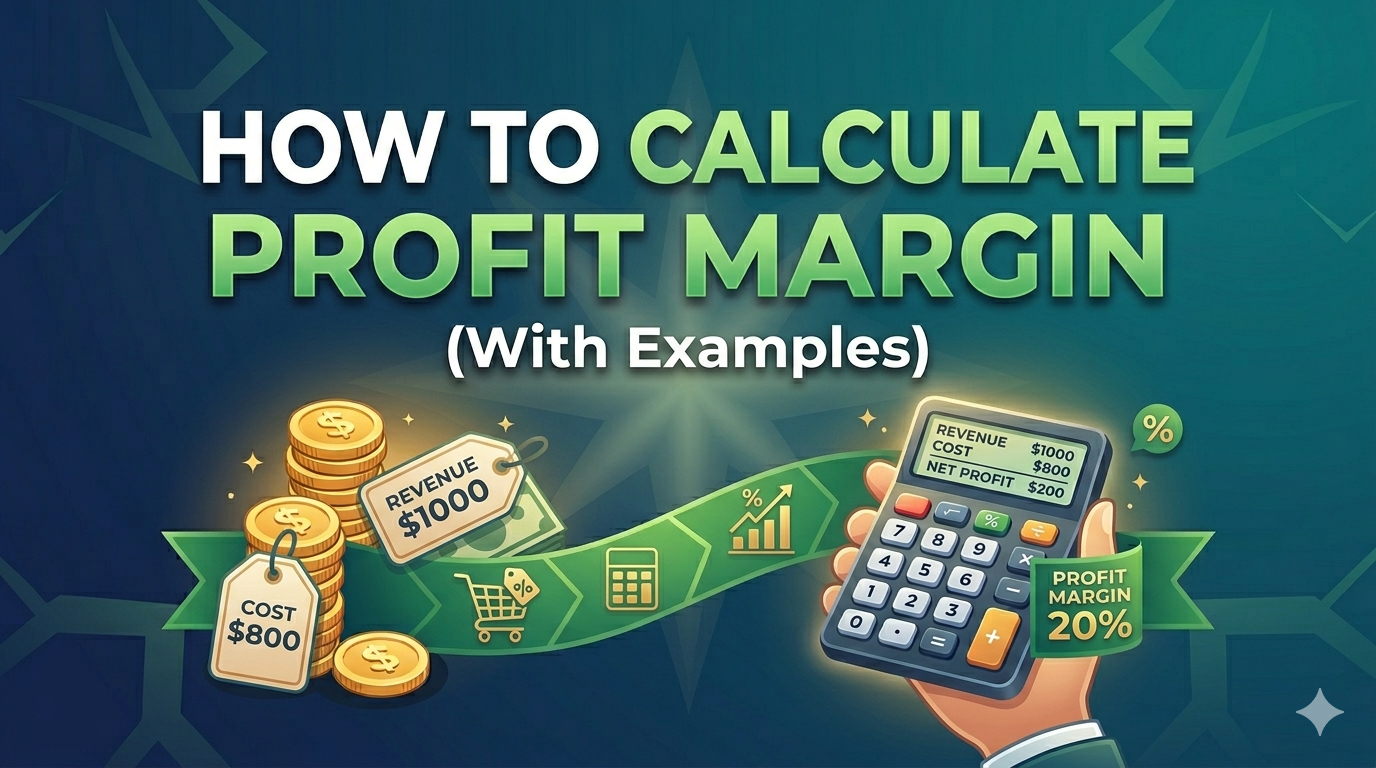
Understanding profit margin is one of the most important skills if you are running any kind of business, selling products online, freelancing, or even managing your own small side income. Many people think that if they are making sales, they are making profit, but that is not always true. In reality, sales and profit are two very different things, and not understanding this difference can lead to serious financial mistakes.
A business can have high sales but still struggle to make real profit. This usually happens when costs are not controlled properly or when pricing is not set correctly. That is why profit margin becomes very important. It helps you understand how much money you are actually earning after covering all your costs.
In this complete guide, you will learn how to calculate profit margin in a simple and clear way. Even if you are a beginner, you will be able to understand everything step by step. We will also go through real examples so you can see how it works in practical situations. And if you want to calculate quickly without doing manual math, you can use this free tool:
👉 https://www.calculatemax.com/calculator/profit-margin-calculator
What is Profit Margin in Simple Words?
Profit margin is a percentage that shows how much profit you make from your total sales. It tells you how much money you are actually keeping after subtracting your costs.
Let’s understand this in a very simple way. When you sell a product or service, you receive money from the customer. But before you can call that money “profit,” you must subtract all the costs involved. These costs can include production cost, buying cost, marketing cost, delivery cost, and other expenses.
The amount left after subtracting all these costs is your profit. Profit margin tells you what percentage of your total sales this profit represents.
So instead of just looking at how much you earned, profit margin helps you understand how efficiently you are earning.
Why Profit Margin is More Important Than Sales
Many beginners focus only on increasing sales. They think that more sales automatically mean more profit. But this is not always true.
For example, if your costs are very high, you may be selling a lot but still making very little profit. In some cases, businesses even lose money while making sales because they are not calculating their costs correctly.
Profit margin helps you avoid this problem. It shows whether your business is actually making money or not. It also helps you decide whether your pricing is correct.
If your margin is low, it means you are not keeping enough profit. If your margin is high, it means your business is more efficient.
This is why smart business owners always track profit margin, not just sales.
Understanding the Profit Margin Formula
The formula for profit margin is simple, but understanding it properly is very important.
Profit Margin = (Profit ÷ Revenue) × 100
Here, revenue means your total sales, and profit means the amount left after subtracting all costs.
Another way to understand the formula is:
Profit Margin = (Selling Price – Cost) ÷ Selling Price × 100
Both formulas give you the same result. They show how much profit you are making compared to your total sales.
Even though the formula looks easy, many people make mistakes while using it. That is why using a calculator can help avoid errors.
👉 You can calculate it instantly here:
https://www.calculatemax.com/calculator/profit-margin-calculator
Step-by-Step Process to Calculate Profit Margin
To calculate profit margin correctly, you need to follow a proper process.
First, you need to find your total sales. This is the amount you receive from selling your product or service. It is important to consider the full amount, not just part of it.
Next, you need to calculate your total costs. This includes everything you spend to create, manage, and deliver your product or service. Many people make mistakes here by ignoring small expenses, but even small costs can affect your final margin.
After that, subtract your total costs from your total sales. This gives you your profit.
Now divide your profit by your total sales and multiply the result by 100. This gives you your profit margin percentage.
This percentage shows how much profit you are making from your sales.
Detailed Example 1 (Basic Understanding)
Let’s take a detailed example to understand this clearly.
Suppose you are selling a product. You buy or produce that product at a certain cost, and then you sell it at a higher price.
The difference between the selling price and the cost is your profit.
Now, when you compare this profit with your selling price and convert it into a percentage, you get your profit margin.
This percentage helps you understand how much profit you are making on each sale.
Detailed Example 2 (Real Business Case)
Now let’s look at a more realistic situation.
Imagine you are running an online store. You have multiple costs such as product cost, packaging, delivery, and marketing.
When you add all these costs together, you get your total cost. Then you compare this with your total sales.
After subtracting costs, you get your profit. When you convert this into a percentage of your sales, you get your profit margin.
This is the number that tells you whether your business is healthy or not.
Types of Profit Margin Explained
There are different types of profit margin, and each one gives a different view of your business.
Gross profit margin focuses only on direct costs like production or purchase cost. It helps you understand how efficient your core business is.
Operating profit margin includes additional costs like salaries, rent, and marketing. This gives a better picture of your business operations.
Net profit margin includes all costs, including taxes and other expenses. This is the most accurate measure of your actual profit.
Understanding these different margins helps you analyze your business in detail and identify where improvements are needed.
Profit Margin vs Markup (Common Confusion)
Many people confuse profit margin with markup, but they are not the same.
Profit margin is based on your selling price, while markup is based on your cost.
Because of this difference, the percentages are not the same, even if the numbers look similar.
This confusion can lead to incorrect pricing and wrong profit calculations. That is why it is important to clearly understand the difference.
Common Mistakes to Avoid
One of the biggest mistakes people make is not including all costs. Even small expenses like packaging or transaction fees can affect your margin.
Another mistake is using the wrong formula. Some people calculate margin using cost instead of selling price, which gives incorrect results.
Some people also focus only on profit amount and ignore margin percentage. This can give a false sense of success.
Avoiding these mistakes is very important for accurate financial planning.
How to Improve Your Profit Margin
Improving profit margin is not just about increasing prices. There are many ways to improve your margin without losing customers.
You can reduce costs by finding better suppliers or improving efficiency. You can also increase your prices if your product has strong demand.
Another way is to improve your marketing so that you get more sales without increasing costs too much.
Small improvements in margin can lead to big increases in overall profit.
Why You Should Use a Profit Margin Calculator
Even though the formula is simple, real-life calculations can become complicated when you have multiple products and different costs.
A calculator makes everything easy. It gives you accurate results instantly and helps you avoid mistakes.
It also allows you to test different scenarios, such as changing price or cost, to see how it affects your profit.
👉 Try it here:
https://www.calculatemax.com/calculator/profit-margin-calculator
Final Thoughts
Profit margin is one of the most important numbers you should understand if you are earning money through any kind of business or service. It tells you how efficient your business is and whether you are actually making profit or not.
Once you understand how to calculate profit margin, you can make better decisions about pricing, costs, and business strategy.
However, to save time and avoid mistakes, using a calculator is always the best option.
👉 Use the free calculator here:
https://www.calculatemax.com/calculator/profit-margin-calculator