
How to Calculate Currency Exchange Rates (Step-by-Step Guide)
Currency exchange rates are something we see almost every day, especially if we deal with international payments, online shopping, freelancing, travel, or global business. But even though the term sounds simple, many people do not clearly understand how exchange rates actually work or how to calculate them correctly.
Most people just check a converter and move on. But if you really understand how currency exchange rates are calculated, you can avoid losses, compare better deals, and make smarter financial decisions. This becomes even more important if you are receiving payments from abroad, sending money internationally, or working with different currencies regularly.
In this detailed guide, you will learn how to calculate currency exchange rates step by step in a very simple way. Even if you are a beginner, you will understand everything clearly by the end.
What is a Currency Exchange Rate?
A currency exchange rate is the value of one currency compared to another currency. It tells you how much of one currency you need to get another currency.
In simple words, it answers a basic question:
“How much money will I get if I convert one currency into another?”
For example, if one currency is stronger than another, you will get more value when converting. If it is weaker, you will get less.
Exchange rates keep changing all the time. They are not fixed because they depend on many factors like demand, supply, economy, and global conditions.
Why Exchange Rates Change Frequently
One important thing to understand is that exchange rates are not constant. They change regularly, sometimes even every second in global markets.
This happens because currencies are traded like any other asset. When demand for a currency increases, its value goes up. When demand decreases, its value goes down.
Economic conditions also play a big role. Factors like inflation, interest rates, government policies, and political stability can affect exchange rates.
Because of this constant change, the rate you see today may be different tomorrow.
How Currency Exchange Rates Are Quoted
Exchange rates are usually shown in pairs. One currency is compared to another.
For example, a rate might show how much of one currency you need to get one unit of another currency. The first currency is called the base currency, and the second is called the quote currency.
If the number increases, it means the base currency has become stronger. If it decreases, it means it has become weaker.
Understanding this basic concept is important before doing any calculation.
Basic Formula to Calculate Exchange Rate
Calculating currency exchange is actually very simple if you understand the formula.
The basic idea is:
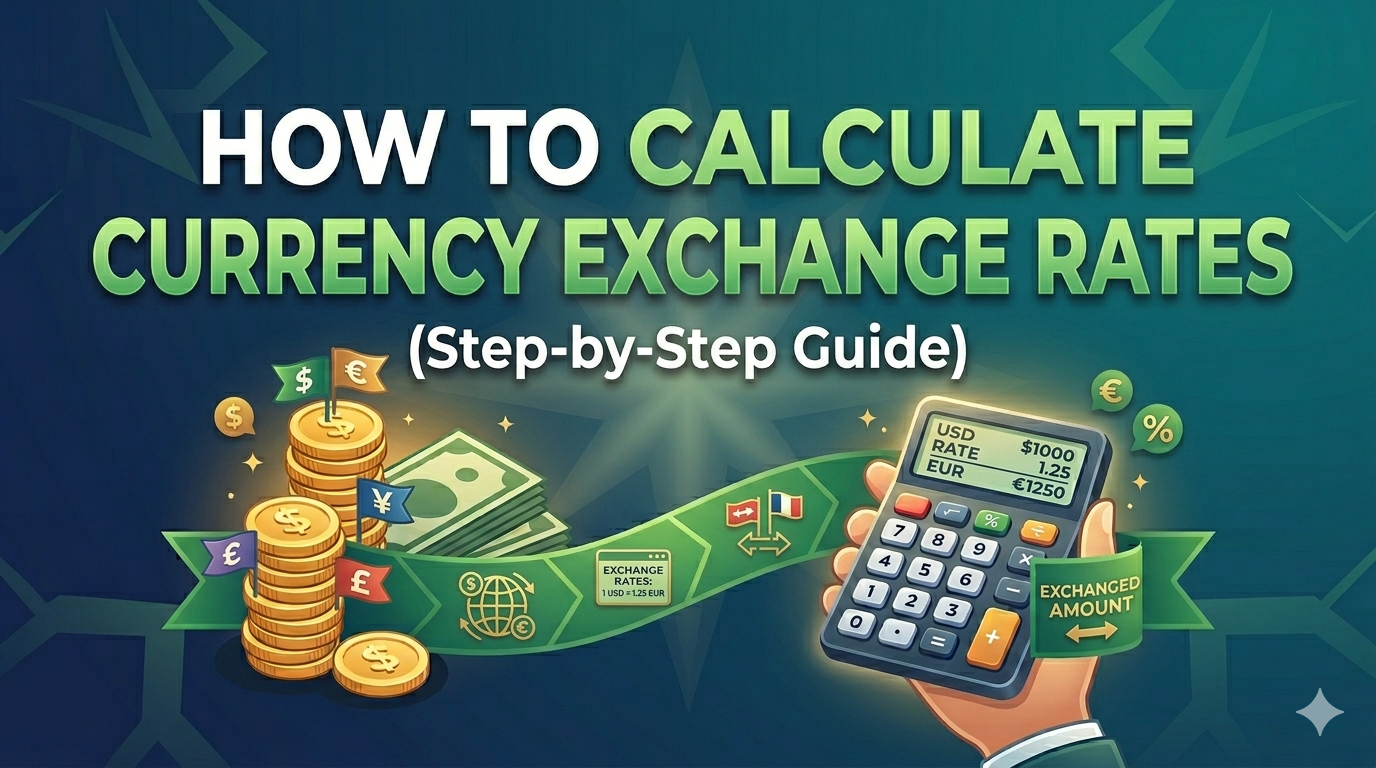
Converted Amount = Original Amount × Exchange Rate
This means you multiply your amount by the exchange rate to get the converted value.
If you are converting in the opposite direction, you may need to divide instead of multiply, depending on how the rate is given.
Even though this looks easy, confusion happens when people do not understand which currency is base and which is quote.
Step-by-Step Method to Calculate Currency Exchange
Let’s break down the process into simple steps so you can understand it clearly.
First, you need to know the amount you want to convert. This is your starting value.
Next, find the current exchange rate between the two currencies. This rate can be found on financial websites or calculators.
After that, multiply your amount by the exchange rate. This gives you the converted value.
If you are converting in reverse, you may divide instead of multiply.
This method works for most simple conversions.
Example 1: Basic Conversion
Let’s understand this with a simple example.
Suppose you have an amount in one currency and you want to convert it into another. You check the exchange rate and multiply your amount by that rate.
The result you get is the amount in the new currency.
This is the most basic form of currency conversion and is used in everyday situations like online shopping or travel.
Example 2: Reverse Conversion
Now let’s look at the reverse case.
Sometimes you know how much you will receive and want to find out how much you need to send. In this case, you divide instead of multiply.
This helps you calculate the original amount required before conversion.
Understanding both directions is important because real-life transactions often involve both types.
Understanding Buy Rate and Sell Rate
In real life, exchange rates are not always the same when you buy or sell currency. There are usually two different rates.
The buy rate is the rate at which you buy foreign currency. The sell rate is the rate at which you sell it.
There is always a small difference between these two rates, and this difference is how banks and exchange services make profit.
Because of this, the rate you see online may not be exactly the same as the rate you get in real transactions.
Hidden Charges in Currency Exchange
Many people think that currency conversion is only about the exchange rate, but that is not true.
In real situations, there are often hidden charges involved. These can include service fees, transfer fees, or slightly higher exchange rates.
For example, online platforms, banks, and payment services may add a small margin to the exchange rate.
This means you may receive slightly less than what the basic calculation shows.
That is why it is always important to check the final amount after all charges.
How Exchange Rates Affect Your Money
Exchange rates have a direct impact on your money, especially if you deal with international payments.
If the rate changes in your favor, you get more value. If it changes against you, you lose value.
This is very important for freelancers, online business owners, and people working with global clients.
Even small changes in exchange rates can make a noticeable difference over time.
Common Mistakes People Make
Many people make simple mistakes when calculating exchange rates.
One common mistake is using the wrong rate direction. They multiply when they should divide or vice versa.
Another mistake is ignoring fees and hidden charges. This leads to incorrect expectations.
Some people also rely on outdated rates, which can cause errors in calculation.
Another common issue is not understanding currency pairs properly, which leads to confusion.
Avoiding these mistakes can save money and prevent errors.
Why Using a Currency Calculator is Better
Even though the formula is simple, real-life conversions can become confusing, especially when rates keep changing.
A currency calculator makes everything easy. It gives you real-time results and reduces the chances of mistakes.
It also helps you compare different values quickly and understand how much you will actually receive.
For anyone dealing with currency exchange regularly, using a calculator is the best option.
Real-Life Uses of Currency Exchange Calculation
Currency exchange calculation is not just for travelers. It is used in many real-life situations.
People use it when shopping from international websites, sending money abroad, receiving freelance payments, or managing global business transactions.
It is also important for investors who deal with international markets.
Understanding exchange rates helps you make better decisions in all these situations.
Tips to Get Better Exchange Value
If you want to get the best value while converting currency, there are a few things you should keep in mind.
Always compare rates from different sources instead of using the first option. Avoid converting money during high volatility when rates are unstable.
Check for hidden fees before making a transaction. Sometimes a slightly lower rate with no fees is better than a higher rate with extra charges.
Planning your conversion at the right time can also help you get better value.
Final Thoughts
Currency exchange rates may look complicated at first, but once you understand the basic concept, they become much easier to manage.
The key is to understand how rates work, how to calculate them correctly, and how to avoid common mistakes.
This knowledge helps you save money, make better financial decisions, and handle international transactions with confidence.
Even though manual calculation is possible, using a reliable calculator is always the easiest and most accurate method.