
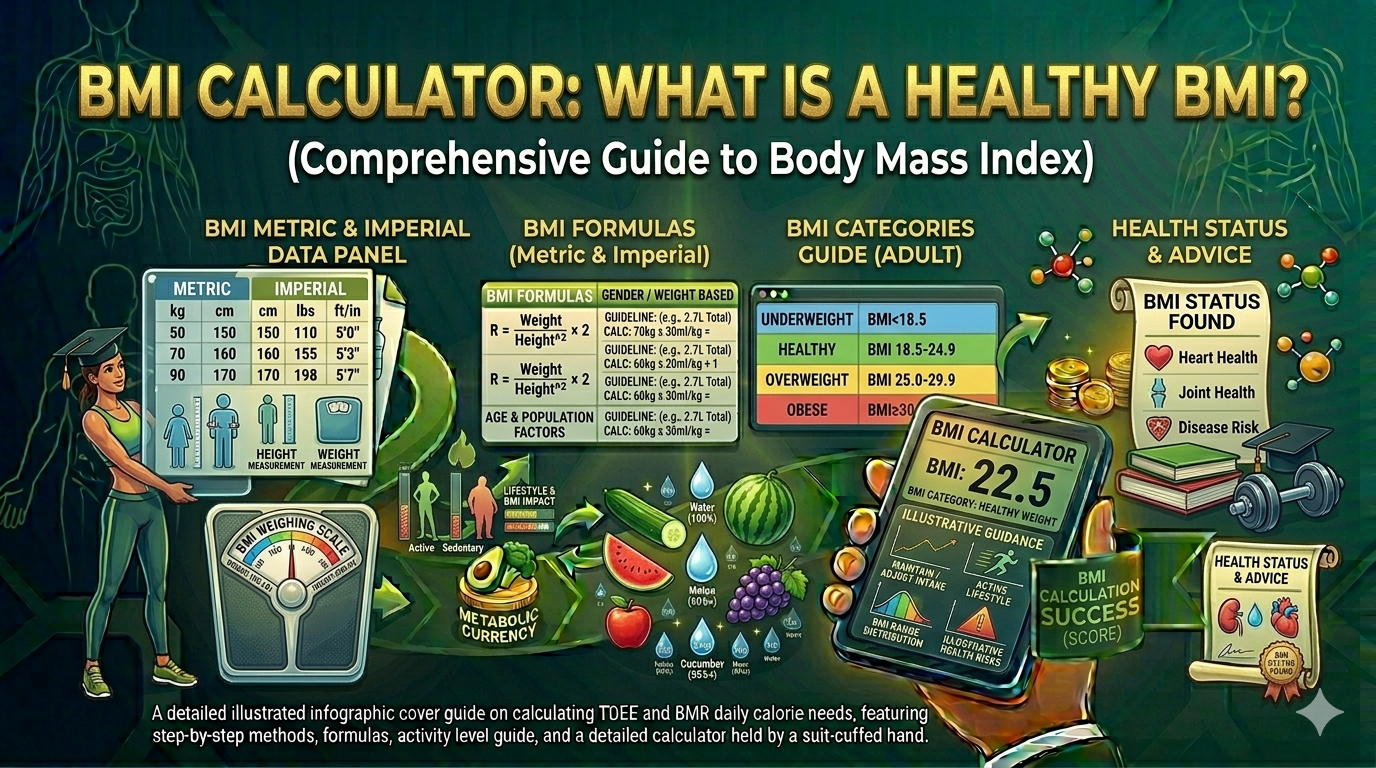
Body weight and health are closely connected, and one of the most common ways people measure body weight status is through BMI. Many people hear about BMI during medical checkups, fitness programs, weight loss plans, and health discussions, but they often do not fully understand what BMI actually means.
Some people think BMI directly measures body fat, while others believe it is a perfect health measurement. In reality, BMI is a simple screening tool that helps estimate whether a person’s weight falls within a healthy range based on height and weight.
Understanding BMI can help people become more aware of their health, fitness goals, and overall body condition.
In this detailed guide, you will learn what BMI is, how BMI is calculated, what is considered a healthy BMI, and the limitations of BMI measurements.
If you want to calculate your BMI instantly, you can use this tool:
👉 BMI Calculator
https://www.calculatemax.com/calculator/bmi-calculator
What is BMI?
BMI stands for Body Mass Index.
It is a numerical value calculated using a person’s height and weight.
BMI is commonly used to estimate whether a person’s body weight falls into categories such as:
Underweight
Healthy weight
Overweight
Obesity
Doctors, fitness experts, and healthcare systems often use BMI as a quick screening method.
Why BMI is Important
BMI helps people understand whether their body weight may affect their health.
Being significantly underweight or overweight can increase the risk of various health problems.
BMI is commonly used because:
It is simple
It is fast
It requires only height and weight
It helps identify possible health risks
Although BMI is not a perfect measurement, it is still widely used around the world.
How BMI is Calculated
BMI is calculated using height and weight measurements.
The formula compares body weight with height to estimate body size.
People with higher body weight relative to their height usually have higher BMI values.
People with lower body weight relative to their height usually have lower BMI values.
👉 You can calculate instantly here:
https://www.calculatemax.com/calculator/bmi-calculator
Understanding Healthy BMI Range
A healthy BMI generally falls within a specific range.
BMI categories usually include:
Underweight
Normal or healthy weight
Overweight
Obesity
The healthy range is considered the category where body weight is generally balanced with height.
However, BMI ranges are guidelines and should not be treated as the only measure of health.
What Does a Low BMI Mean?
A very low BMI may indicate that a person is underweight.
Being underweight can sometimes be linked with:
Nutritional deficiencies
Low energy
Reduced muscle mass
Weak immune function
However, naturally thin individuals may also have low BMI without major health issues.
This is why BMI should always be viewed carefully and in context.
What Does a High BMI Mean?
A high BMI may indicate overweight or obesity.
Higher BMI values are often associated with increased health risks such as:
Heart problems
High blood pressure
Diabetes
Joint issues
However, BMI alone cannot fully determine health status.
Some individuals may have higher BMI because of increased muscle mass instead of excess body fat.
Difference Between BMI and Body Fat
Many people confuse BMI with body fat percentage.
BMI only estimates body weight relative to height.
It does not directly measure:
Body fat
Muscle mass
Bone density
Body composition
For example, athletes with high muscle mass may have high BMI even if they have low body fat.
This is one of the biggest limitations of BMI.
Step-by-Step Method to Calculate BMI
Calculating BMI becomes easy when you follow the proper method.
First, measure your body weight accurately.
Next, measure your height.
Then apply the BMI formula using height and weight values.
The final result places you into a BMI category.
👉 You can calculate instantly here:
https://www.calculatemax.com/calculator/bmi-calculator
Example of BMI Differences
Let’s understand this with a simple example.
Imagine two people with the same body weight but different heights.
The shorter individual may have a higher BMI because the same weight is distributed over a smaller height.
Similarly, taller individuals may have lower BMI with the same weight.
This shows why height is an important part of BMI calculation.
BMI and Weight Loss Goals
Many people use BMI as part of their weight loss journey.
BMI can help estimate whether a person may need to lose or gain weight.
However, healthy weight management should also include:
Nutrition quality
Physical activity
Muscle health
Lifestyle habits
BMI should be viewed as a general guide instead of the only health measurement.
BMI and Fitness
Fitness and BMI are related but not exactly the same.
A person can improve fitness through exercise, strength, endurance, and healthy habits even if BMI changes slowly.
Similarly, someone may have a healthy BMI but poor fitness habits.
This is why overall health matters more than BMI alone.
Why BMI is Widely Used
BMI remains popular because it is:
Simple
Quick
Low-cost
Easy to calculate
Healthcare systems use BMI for large population studies and basic health screening.
It helps identify possible weight-related risks efficiently.
Limitations of BMI
BMI has several limitations.
It does not distinguish between:
Fat and muscle
Different body types
Fitness levels
Body composition
BMI may also vary depending on age, gender, and ethnicity.
Because of this, BMI should not be treated as a perfect measurement.
BMI for Children and Adults
BMI calculation differs slightly for children and adults.
Children’s BMI is often compared using age and growth charts because children grow continuously.
Adult BMI categories are more stable because body growth is complete.
Common Mistakes People Make
Many people focus too much on BMI numbers alone.
Some assume a healthy BMI automatically means perfect health.
Others panic after seeing slightly high or low BMI values without considering overall fitness and lifestyle.
Another common mistake is comparing BMI results between people with completely different body compositions.
Understanding BMI properly helps avoid these misunderstandings.
Why Online BMI Calculators Are Helpful
Manual BMI calculation can become confusing for some people.
An online calculator makes the process quick and accurate.
You simply enter:
Height
Weight
The calculator instantly calculates BMI and shows the result category.
👉 Use it here:
https://www.calculatemax.com/calculator/bmi-calculator
Real-Life Importance of BMI
BMI is commonly used in:
Healthcare
Fitness programs
Weight management
Medical screening
Insurance evaluations
Understanding BMI helps people become more aware of their health status and body condition.
Tips for Maintaining a Healthy BMI
Eat balanced meals.
Stay physically active.
Exercise regularly.
Focus on long-term healthy habits instead of quick fixes.
Get proper sleep and hydration.
Monitor body weight regularly without becoming overly dependent on BMI numbers.
BMI and Overall Health
A healthy lifestyle is more important than focusing only on BMI.
Nutrition, exercise, sleep, stress management, hydration, and mental health all contribute to overall wellness.
BMI is simply one tool among many used to understand body health.
Final Thoughts
BMI is a simple and widely used method for estimating whether body weight falls within a healthy range based on height and weight.
While BMI is useful for general screening, it is not a complete measure of health or body composition.
Understanding BMI properly can help people make smarter health and fitness decisions without becoming overly focused on numbers alone.
👉 Try it here:
https://www.calculatemax.com/calculator/bmi-calculator